
But Shiva has different aspects that appear at different times. Shiva is often depicted as the destroyer, and will appear as a naked ascetic accompanied by demons, encircled with serpents and necklaces of skulls. Sometimes Shiva wanders into crematoriums, smears his body with ash and dances in the light of the funeral pyres, reminding all about the transitory nature of material things.
Another common form is that of Dancing Shiva Nataraja. This is Shiva engaged in a cosmic dance. It is believed that the energy from this dance sustains the cosmos, and when Shiva is finished with this dance, this universe will end and a new one will begin. Sometimes the creative force of Shiva is depicted, and in particular Shiva is represented by a phallus, known as the lingam. Other times Shiva is seen in statues as the god of meditation and asceticism. He will be depicted sitting cross-legged with his eyes half-closed.
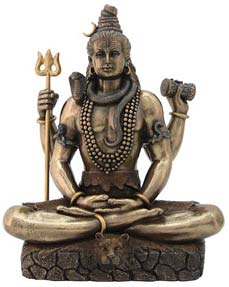 Shiva MeditationThe God of Destruction Is also The God Of Yoga Price: $83.95 |
Shiva’s Family Ties
One of the many complexities about the God Shiva is his role as a head of household. According to different sources, he has several wives, with the major Hindu Goddess Parvati being one of them, and the lesser Hindu Goddess Ganga being another. While the majority of stories detailing the Shiva’s romantic side deal primarily with his relationship with Parvati, he is also respected for his willingness to throw himself at the feet of another consort, the Goddess Kali in order to stop her blood thirsty rampage of destruction. As for his offspring, One of his sons, Ganesh, is the elephant headed god of success who is recognized and worshipped nearly universally throughout Hindu India. Another son, Skanda, is worshipped primarily in Southern India.
Shiva’s Symbols and Iconography
Snakes are often associated with Shiva, since they are able to regenerate their skins by discarding their old ones. Likewise, in southern India, deer are associated with Shiva because their antlers re-grow after falling out. Shiva is also associated with the rainy season, as the monsoon rains transform the ground from dessert into fertile valley. Shiva rides upon his mount, Nandi the Bull, which is also worshipped by some groups as a deity in its own. As Rudra, Shiva is depicted with a Deer. As an ascetic, Lord Shiva may be depicted sitting upon a tiger pelt. Shiva is most commonly depicted with four arms.
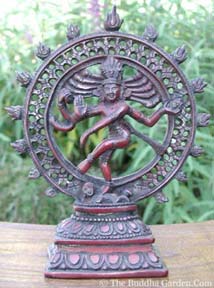 Resin ShivaIs Indian dance influenced by the poses of the Gods and Goddesses?Price: $34.95 |
In the Dancing Shiva Nataraja form, the left leg is lifted slightly off the ground, and this rising up represents liberation (as in freedom from attachment, or liberation from samsara). The right leg is slightly bent and tramples upon a demon, representing the conquest over ignorance. A halo surrounds the King Of The Dance, and the flames in the halo represent Angi The God Of Fire.
Another form is of Shiva and Parvati combined into one image, where the right side of the statue depicts Shiva, while the left hand side of the statue depicts his consort Parvati. This is referred to as a Shiva Shakti or a Hari Hara (Day and Night) statue, among other names.
But Shiva is not always represented in anthropomorphic (human-like) form. One of the most common representations is that of a lingam – a stone phallic symbol – that is venerated in temples. This form is said to house the creative energy of the universe, and so during pooja (worship), milk is poured over the lingam to cool it. Sometimes the lingam will have an image of Shiva’s face carved into the stone as well, and in at least one instance, there is a tall standing lingam with a representation of the entire body of Shiva carved into it.
The Weapons of Shiva
Many Hindu Gods and Goddesses carry weapons, and Shiva is often depicted carrying a trident, as the three tips of this weapon represent the creation, protection (or sustaining), and destruction of the universe. Because he is so closely associated with ascetics, who renounce the world in search of spiritual enlightenment, Shiva is often depicted carrying an ax, which is to symbolize the severing of ties to the material world. But undoubtedly Shiva’s most powerful weapon is his Third Eye in the middle of his forehead, which, when opened fully, can incinerate man, demon, or god.
See Also:
Mahashivaratri Festival
The Great Night of Shiva is a celebration of this Hindu God.
It is believed by devotees of Sri Shiva that Sri Ganga, the Goddess of the sacred Ganges River, resided in the heavens with the other Hindu deities. However, she ran afoul of the Gods there (there are several different explanations why), and she was banished from Heaven. She threatened to crash to the earth and flood the whole planet, so the Gods implored Lord Shiva to do something about the impending doom.
Lord Shiva caught the falling Goddess Ganges in his matted hair to break her fall, where she resides today, and she is considered a consort of Lord Shiva.
This may be part of the reason that Lord Shiva is considered the God of Rebirth, since the Ganges River floods in a yearly cycle (coinciding with the monsoon seasons) and it is this flooding that helps bring water to the crops that lie in the flood plain. In essence, Shiva, via his consort Ganga, "rejuvenates" the land by bringing much needed water to crops.
This is similar to how the Crescent Moon became associated with Shiva, since the moon appears and disappears (waxes and wanes) cyclically. To the ancients, they believed the moon was "reborn" every lunar month.
